A Crystal Radio is a simple radio receiver that uses a semiconductor crystal as a primitive diode for demodulating AM signals, and generally requires no external power source other than the radio waves themselves, though a biasing battery may sometimes be added to improve sensitivity.
A typical crystal radio is built with a few simple parts: An antenna, an optional ground connection, a coil (inductor), a capacitor, a solid state diode and a high impedance earpiece or amplifier.
The construction of these parts can vary depending on available materials and personal preference.
Antenna
Crystal radios often work using large, long wire antennas to capture enough radio energy to power the earpiece. Such receivers need to be provided with a ground connection. They may also use long dipole antennas in which the ground connection may be ommited, as can be done with loop and loopstick antennas.
Ground connection
An electrical connection to the soil providing a path to close the RF circuit formed by the antenna and ground. Any sufficiently large piece of metal buried in soil or submerged in a body of water would suffice. A piece of copper pipe just 10-20 cm long stabbed into wet soil can work satisfactorily. Traditionally, cold water pipework provided a very useful ground connection (when made with copper pipes). The ground terminal of household electrical outlets may be used.
Coil (Inductor)
Forms one half of the tuned circuit used to filter out a specific station, the other half being the capacitor. The coil is made from thin insulated wire, coiled around a form made of non conductive material, usually a hollow cardboard or plastic tube, or a piece of wood.
For tuning, the coil may have evenly spaced taps (twisted pigtails of the wire poking out of the coil surface, with the insulating material removed from it so alligator clips can connect to it) to adjust how many turns are part of the circuit, or alternatively using a sliding contact along a sanded side of the coil for the same purpose, but allowing finer tuning.
When using a loop or loopstick antenna, the antenna replaces the coil. The loop needs to have a large surface area to capture enough magnetic flux to power the earphone, about 30 cm in diameter or larger if round.
Loop antennas or coils without taps are better used when there is a good notion of their inductance and a suitable variable capacitor is available, otherwise tapped or sliding coils are better used to allow the trial and error of finding the right inductance to tune in stations when paired with the available capacitor. Tapped coils may work well with homemade variable capacitors (which tend to have smaller capacitance ranges than manufactured ones), while sliding coils may work well with low, fixed value capacitors (such as two stacked coins separated by a layer of tape or paper) due to the finer tuning allowed at the inductor.
Capacitor
Forms the other half of the tuned circuit along with the inductor. They are made by stacking metal plates or foils with an insulator between them, so they share a large surface area facing each other without any electrical connection between the two plates. A fixed, low value capacitor may be used with a sliding coil, or a variable capacitor (where one plate is somehow made movable to adjust the overlapping surface area) may be used with a fixed or tapped inductor.
A variety of capacitors can be easily made by coiling together strips of paper and aluminum foil, variable capacitors are more elaborate and there is a variety of designs. They may also be harvested from old broken radios.
A crystal radio using a long wire antenna and a sliding coil may not need a capacitor if the antenna itself provides enough capacitance.[1]
Crystal Detector
The detector or demodulator in a crystal radio is an (often primitive) semiconductor diode. The diode functions as a demodulator by rectifying the AM signal, and producing a spiky DC waveform with peak values that are proportional to the amplitude of the AM signal. The earphones, behaving like a low pass filter, respond only to the audio frequency components of this waveform, which happens to be the audio of the broadcast.
A large variety of diodes have been used in crystal radios, some of the most notable ones are listed as follows:
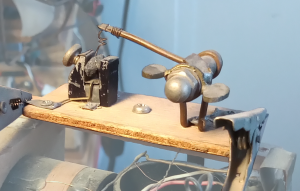
Cat's whisker detector: The typical detector from which the crystal radio gets its name. This type of device uses a piece of raw semiconductor crystal material in a primitive point contact diode (specifically a Shottky barrier diode). The semiconductor is held in a metal clamp, forming one of the electrodes, and is lightly touched with a pointed metal contact, usually a needle or thin wire (the "cat whisker"). This connection is made movable so the user can search for a spot on the crystal where the device will function, typically by attaching the wire to the end of a movable arm.Cat's whisker in a homebuilt radio, using a small piece of Galena (lead sulfide) clamped on the left side, and being contacted by a thin wire mounted on an adjustable swivelling arm.A variety of semiconductor materials were used, both natural minerals and synthetic materials.
Metal sulfides: Pyrite (iron sulfide) and Galena (lead sulfide) were common minerals used in crystal detectors, chalcopyrite and bornite work as well.
Silicon and Silicon carbide: Synthetic materials, which may require a biasing battery due to the higher voltage required for them to conduct.
Metal oxides: Thin oxide films on the surfaces of many metals have semiconductor properties. Blued steel razor blades were famously used in so called "foxhole radios" hand built during WWII, copper oxide on tarnished coins can also function in a crystal detector. These metal oxide detectors sometimes used a graphite pencil in place of the metal whisker.
Germanium diodes: Manufactured germanium diodes became common after WWII and were used in contemporary crystal radios, they offered good performance and no need for adjustment of the point contact. They can be obtained from surplus or scrapped from pre-1980's electronics. Particularly, they often were used in the detector stages of transistor radios.
Other diodes: Some modern silicon diodes, as well as light emitting diodes and laser diodes, can function as detectors at lower frenquencies (such as the AM broadcast band) if biased using a battery.
Earpiece
Not any headphone will work with a crystal radio (at least, not directly). Earpieces for crystal radios need to have a high impedance and high sensitivity. Specifically made piezoelectric earphones are sold for crystal radios, they may also be fashioned out of piezoelectric buzzers though not as sensitive. High impedance earphones of the moving iron type can be made by hand.
Low impedance earphones may be adapted to work with a crystal radio using a transformer, such as one taken from an old style wall adapter with a mains connected transformer, with a low voltage secondary of around 12 V or less. The secondary of the transformer connects to the earphone while the primary connects to the receiver at the same place a high impedance earphone would.
An amplifier may also be connected in its place, a parallel resistor of a few thousand ohms may be necessary to allow some DC current flow through the diode.